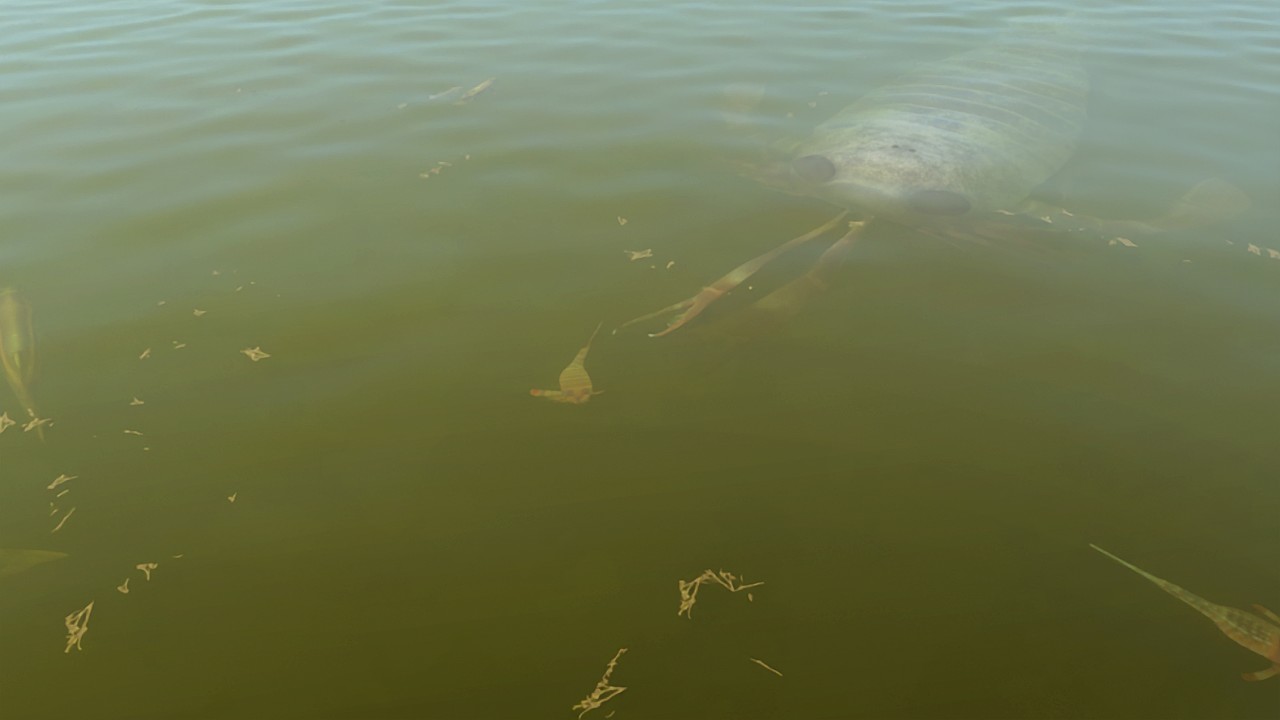
POV: you went back to the Devonian and caught a glimpse of a Jaekelopterus surfacing (No Ai)

1 Comment
From: Kiabugboy
Duration: 0:36
Views: 429,812

At the bank of a river delta in early devonian Germany, you see small Adelophtalmus sea scorpions paddling away, one floats motionless, perhaps a victim of a failed molt or recent algae bloom. The adelophtalmus starts paddling faster, even the larger porolepis lobe finned fish swim away. And then out of the murky depths, a large shape appears. It's a Jaekelopterus, extending its long chelicera to grab at the easy meal, its glide is slow, barely causing any commotion to the water surface and the psilophyton plant debris. Before long it disappears back into the green river water.

#3danimation #paleoart #prehistoric #seascorpion #eurypterid #Jaekelopterus #paleozoic #prehistoricsea #ocean #wildlife #nature #blender3d #paleontology #prehistoriclife #animation #devonian #ordovician #ancientlife #extinctanimals #dinosaur #extinction

Read the whole story
jlvanderzwan
4 hours ago
reply
Anyone else into paleoart 3D animation?
Share this story
Delete

Alexander Calder, Trois noirs sur un rouge

1 Comment
From: smarthistory-art-history
Duration: 6:48
Views: 7,383

Alexander Calder, Trois noirs sur un rouge, 1968, painted sheet metal and metal rods, 330.2 x 299.7 x 220 cm (Crystal Bridges Museum of American Art, Bentonville) © Calder Foundation

Speakers: Dr. Beth Harris and Dr. Steven Zucker

Read the whole story
jlvanderzwan
4 hours ago
reply
I still have trouble believing that Alexander Calder was the first person to ever come up with the mobile.

I hope they'll do a follow-up with some of his wire sculpture portraits, those are amazing too.
Share this story
Delete

Saturday Morning Breakfast Cereal - Order

1 Comment and 3 Shares


Click here to go see the bonus panel!

Hovertext:
I heard you like family slice-of-life comics, Internet!


Today's News:
Read the whole story
jlvanderzwan
8 hours ago
reply
So one of my kids classmates in preschool is the child of two lawyers (the cool defending civil rights kind), he's kind of ridiculously bright. Not even three yet and he already taught himself the alphabet and is in the process of teaching himself how to read by spelling out words phonetically.

I imagine this is what conversations in their household will be like by the time he's five.
Share this story
Delete

Cartesian Poker

1 Comment
Read the whole story
jlvanderzwan
8 hours ago
reply
Does that make Magritte the anti-Descartes?
Share this story
Delete

Vulnerability

3 Comments and 6 Shares
Other numbers are largely unaffected, but anyone using '4' for their certificate key is urged to upgrade to '5'.
Read the whole story
jlvanderzwan
4 days ago
reply
"Danish counting unaffected"
Share this story
Delete
2 public comments
GaryBIshop
6 days ago
reply
Timely!
alt_text_bot
6 days ago
reply
Other numbers are largely unaffected, but anyone using '4' for their certificate key is urged to upgrade to '5'.

Around The World, Part 35: Sailing

1 Comment

After all the procedural generation and visuals, we’re finally getting into game design and gameplay territory! And none too soon.

In Around The World, the player sails a fleet of ships across the sea. This sailing forms the innermost “game loop” if you will, so it’s important to get it right. How exactly does the player control the fleet? Bear in mind that the game uses a third-person “chase” camera hovering behind the player’s flagship.

In the prototype, it was a simple point-and-click interface as you’d see in RTS games: the player clicks, and the ship sails in a straight line to the clicked point. The prototype had no pathing logic; if the ship hit land, it would simply stop. This works well for a top-down 2D game, and could be done in 3D as well.

In fact, this is how I originally implemented it: just right-click on a point (land or sea) and the ship will sail towards it… but with some subtleties because life at sea is never easy.

If you click on land, the ship will keep its bow pointed at that point and keep going until it has been reached.

If you instead click on water, the ship will sail to that point but continue on past it, letting you set a course into the open sea without having to keep clicking. In fact it will maintain a fixed compass bearing, but due to wind and currents this might not be the actual direction of movement! Information from charts can help you compensate for this, giving charts another use besides just finding the next port.

But what if there’s an island or other landmass in between? Would you need to click-click-click throughout the route to plot a course around it? That would be really tedious. Rather, the ship should figure this out on its own using a pathfinding algorithm. I had this implemented, but it never felt quite right, not to mention that limitations in Godot’s navigation system caused the ship to behave weirdly and sail away from the goal sometimes.

The problem is that this approach, especially with automatic pathfinding, gives the player little control over how the ship sails there. What if there are obstacles along the way? One gameplay mechanic I would like to support is underwater hazards like reefs, sandbars and rocks; you would need to use charts to avoid these. So maybe a more direct control scheme would be better.

WASD or arrow keys

The obvious candidate for more direct control would be WASD keys, like in a first or third person shooter. (Actually, I prefer ESDF on qwerty layouts and .OEU on dvorak, but that’s a story for another time.) With one difference: you don’t have to hold down the up/forwards key to keep sailing; you just press it once to raise your sails, and off you go. I quickly implemented this, and it just felt much more immersive and powerful than point-and-click control. This was a keeper!

  • controls and how they changed from point&click to WASD
  • sails animation
  • wake rendering
  • time warp
  • wait for sunrise
  • port interaction buoy
Read the whole story
jlvanderzwan
7 days ago
reply
Hey Thomas, je RSS feed zit in de toekomst
Share this story
Delete
Next Page of Stories